The Bend Catalog: Mapping an Instrument's Glitch Vocabulary
An overnight session driving sixteen control channels one at a time — photographed off the CRT, swept, combined, and fingerprinted from the waveform. The result is a classified vocabulary: which channels wash, which smear, which behave like knobs and which like switches.
A glitch device with sixteen control channels does not have a known vocabulary. It has folklore — a few looks somebody stumbled into once. Until every channel has been driven alone, photographed, classified, and fingerprinted, you own a box, not an instrument. This session was the mapping.
The setup: a source clip paused so every capture compares like-to-like, its composite signal run through the device, displayed on a CRT, filmed off the screen — and the waveform digitized alongside every photograph, so each glitch exists as both a picture and a signal. Control is optical: each channel is a different LED/photocell pairing into the device’s control-resistance nodes, with drive set per channel from 0 to 255.
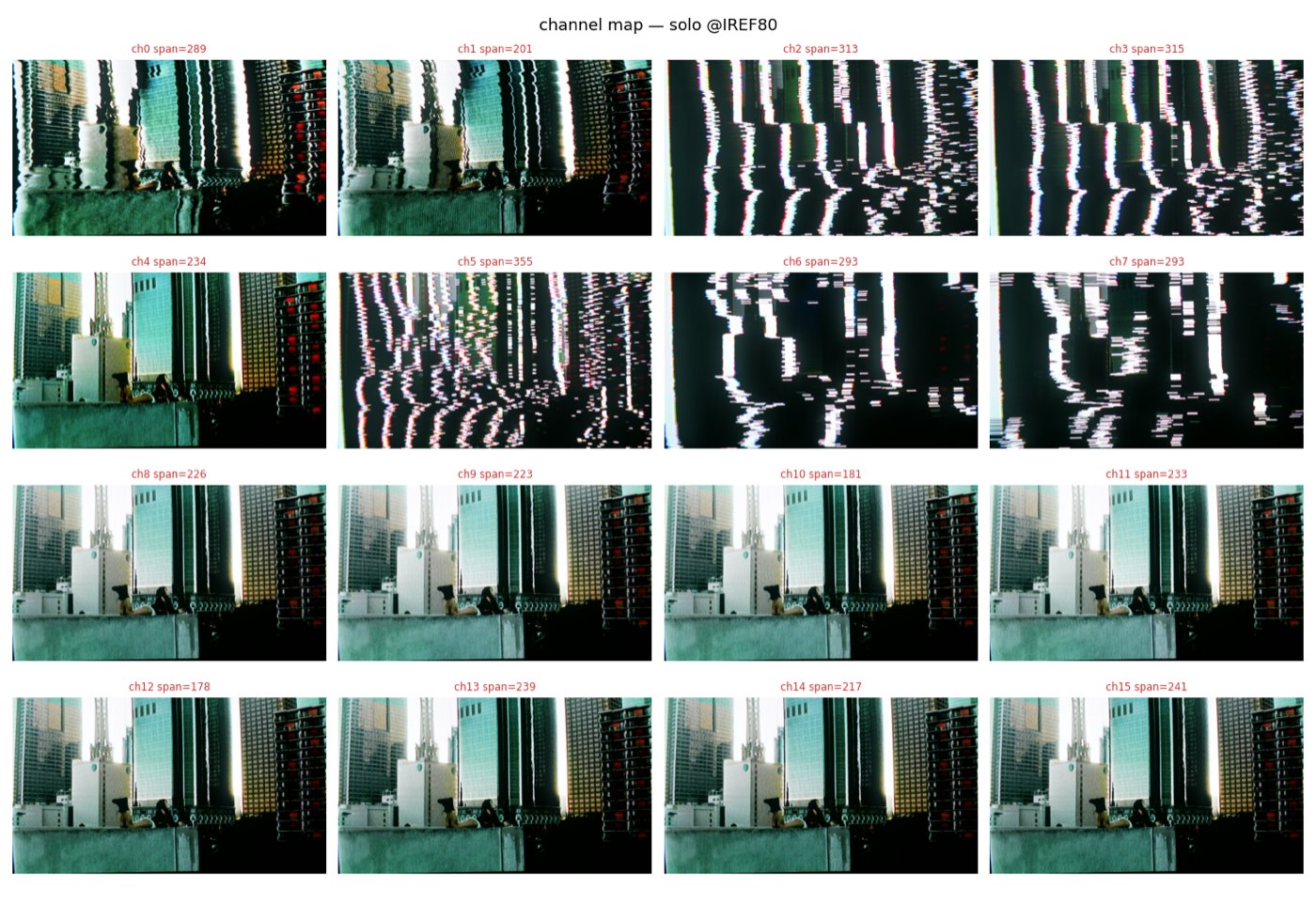 FIG. 1 — All sixteen channels solo at drive 80 on one frozen frame. Channel 5 is a near-total sparkly wipe; 2 and 3 drag the image sideways into wavy-band smear; 6 and 7 tear; 8 through 15 dither gently and leave the picture readable. Source: channel-map contact sheet.
The channels have distinct personalities, and no two are redundant. Sweeping drive on each one exposed a second distinction the single-level map cannot show:
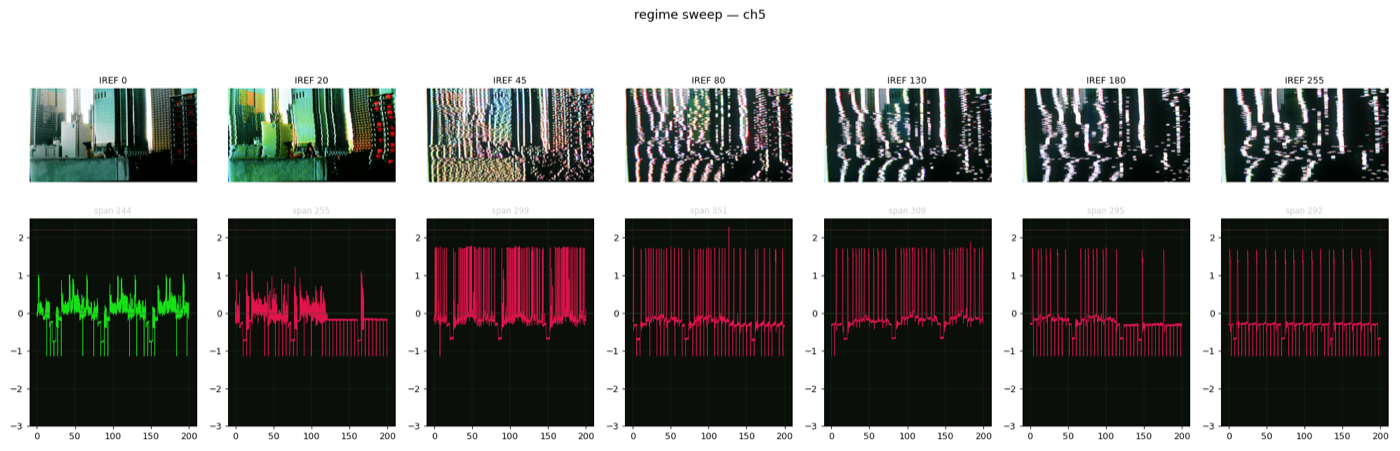 FIG. 2 — Drive sweep on channel 5, picture over waveform: clean, then color-shift, peak chaos near drive 80, then a calmer vertical-line regime at full drive. Channel 2, by contrast, slams to full smear by drive 20 and holds there. Source: regime-sweep contact sheet.
Some channels are knobs — expressive, playable, non-monotonic. Others are switches: on or off, nothing between. That is a design fact about the instrument you only learn by sweeping.
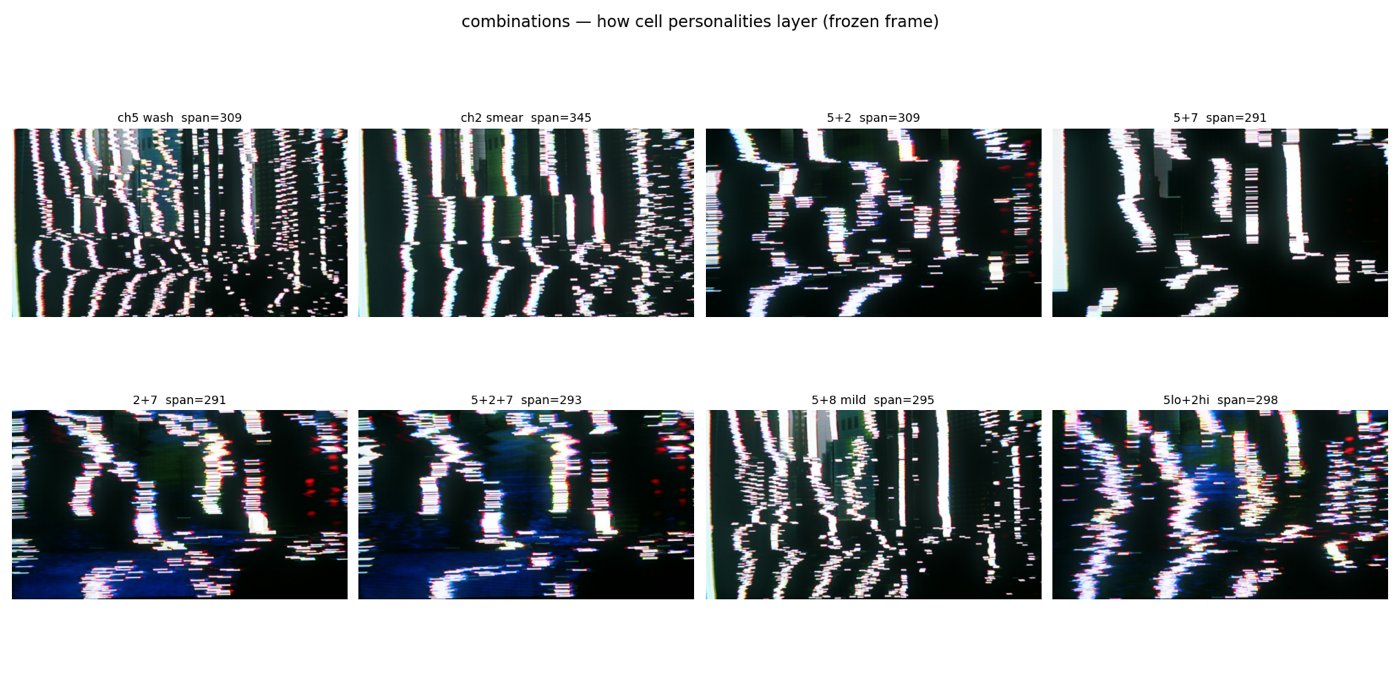 FIG. 3 — Pairs and triples on the frozen frame. Numeric disruption does not add — 5+2 measures below channel 2 alone — but the textures layer: wash crossed with smear yields a woven cross-hatch neither channel produces by itself. Source: combinations contact sheet.
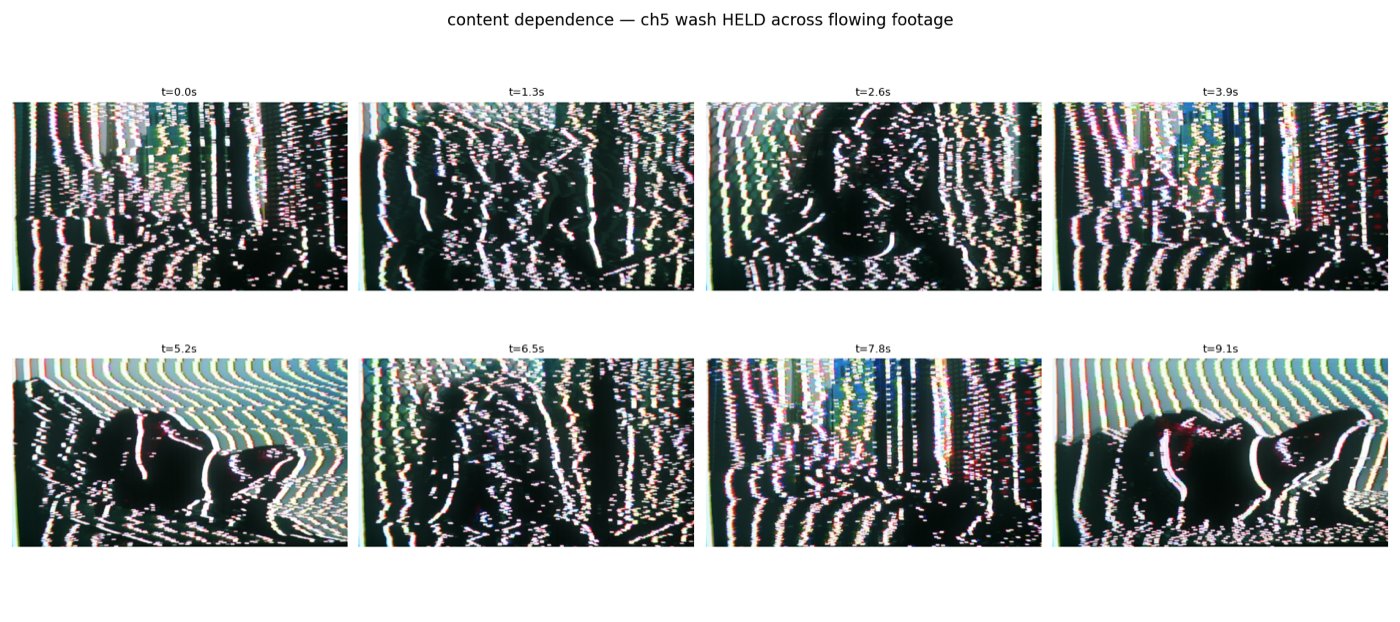 FIG. 4 — The channel-5 wash held constant across ten seconds of flowing footage. Bright frames render as stripe-wash; dark figures render as wavy ripples rolling through the blacks. Source: content-dependence contact sheet.
FIG. 4 is the finding that reshapes the catalog format: a glitch is bend times content, not a fixed look. An entry has to say what a bend does on a content type.
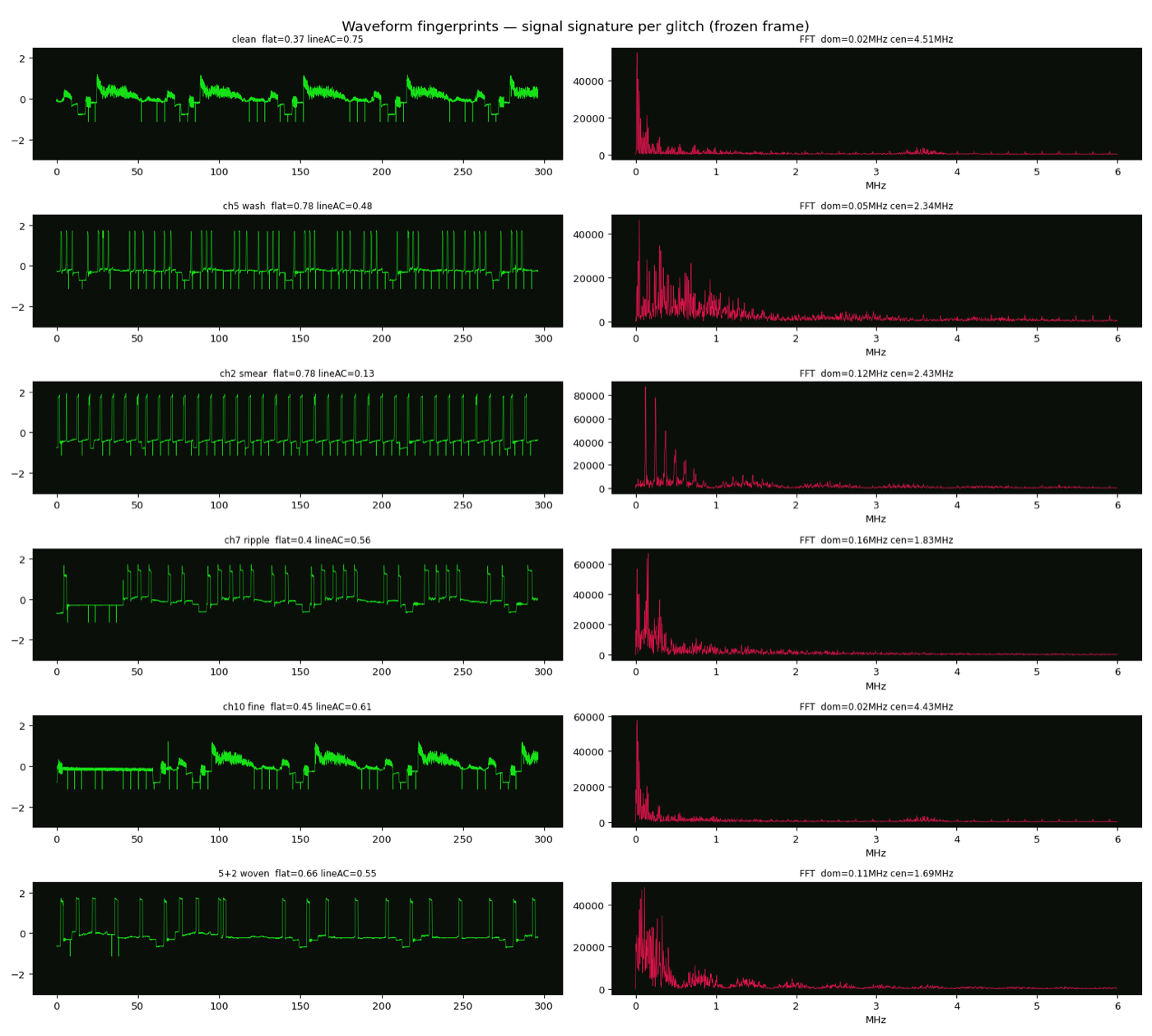 FIG. 5 — Waveform and spectrum per glitch. Three computed features — flatness (content crush), spectral centroid (surviving detail), and autocorrelation at the 63.5 µs line period — map cleanly onto the looks. The horizontal smear’s line-lag autocorrelation reads 0.13 against a clean 0.75: that smear is line-timing collapse, legible straight off the signal. Source: fingerprint sheet.
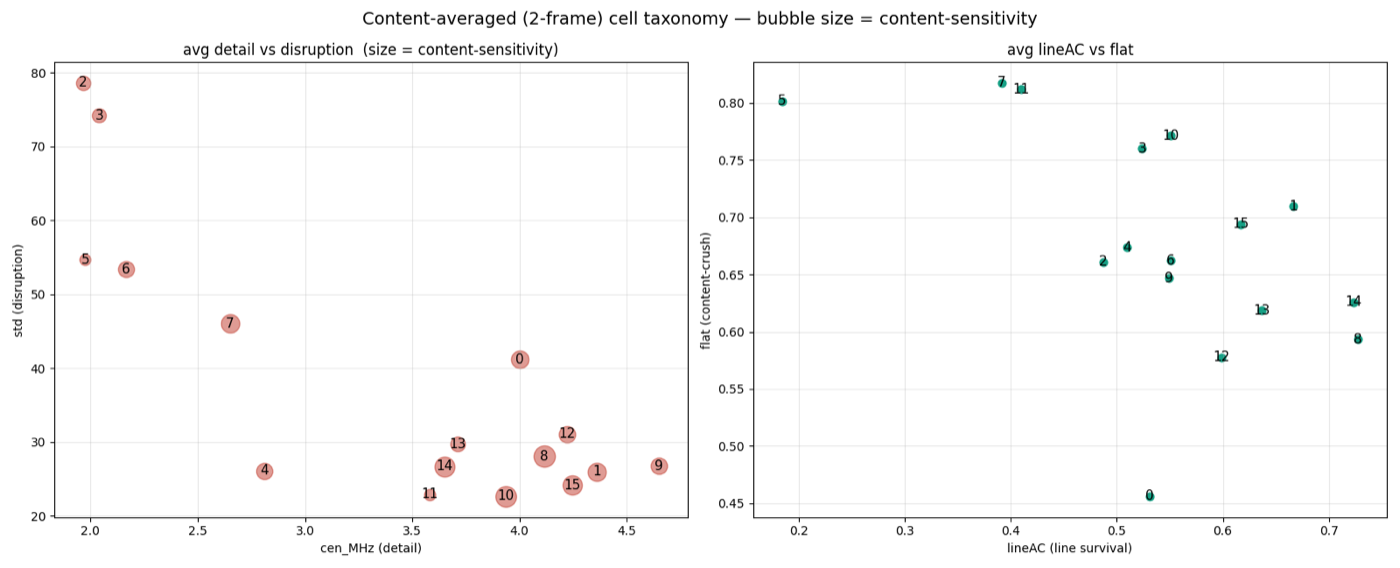 FIG. 6 — All sixteen channels fingerprinted on two different frames and plotted. The destructive channels cluster apart from the fine ones, and bubble size adds a third axis: destructive channels obliterate content, so they look the same on any footage; fine channels ride the picture. Predictable versus content-reactive. Source: content-averaged taxonomy plot.
One discipline underneath all of it: no setpoint gets sampled once. Other sessions on this bench have shown a single control coordinate hosting two alternating glitch states, and onset thresholds drifting with the photocells’ light history. A single sample per point undercounts, so each coordinate is revisited and the set of observed states recorded. The session’s own notes flag the same humility — the numeric disruption metric is a crude proxy, and visual review stays mandatory.
Why bother? Because a bend you can’t reproduce isn’t an instrument feature — it’s weather. The catalog is the difference: named channels, measured regimes, signatures you can read off a waveform, and combinations you can call up on purpose.